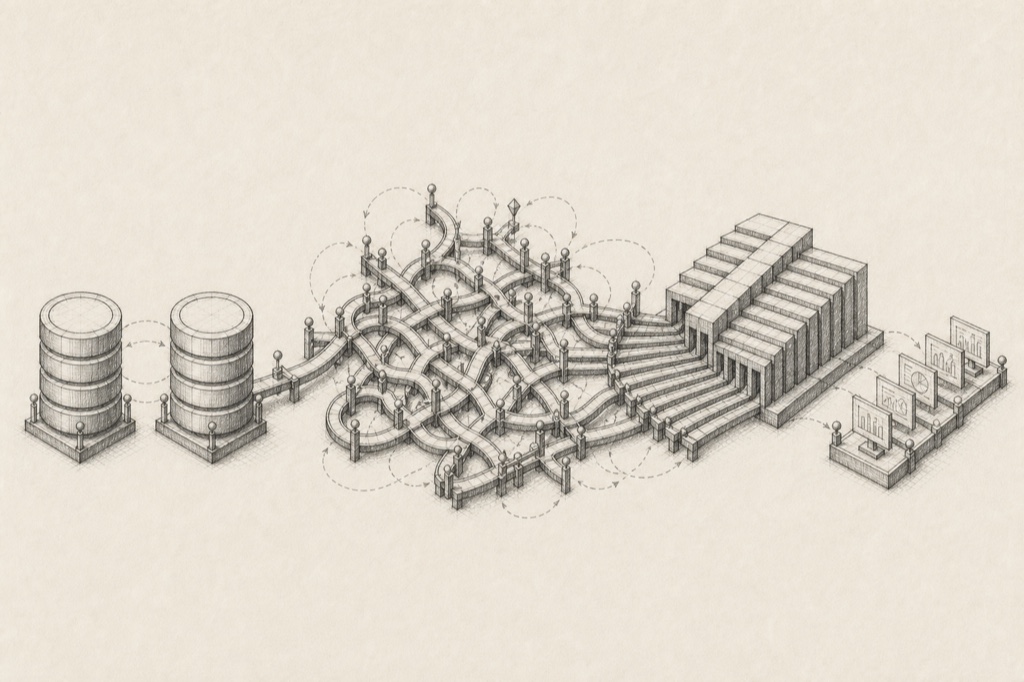
A Metabase-on-read-replica setup is a BI tool querying a copy of the production database. It is a useful first analytics architecture, not a warehouse and not a substitute for modeled metrics.
If your company's Metabase instance is connected directly to a read replica of the production database, we should probably talk.
Not because this architecture is absurd.
For an early-stage company, it is often the right first step. The application already stores most of the data the team cares about. Metabase is easy to deploy. A read replica keeps analytical queries away from the primary database. In a few hours, someone can build the first dashboards without introducing a warehouse, ingestion pipelines, or another system to operate.
That is a good trade when the company is small and the questions are simple.
The problem is that the temporary shortcut rarely stays temporary. More people start using the dashboards. Finance asks for revenue. Product needs activation and retention. Operations wants current statuses. Marketing brings data from ad platforms and a CRM. Definitions become more important, queries become more complex, and the replica quietly becomes the company's data platform.
It was never designed to be one.
A Read Replica Solves the Wrong Scaling Problem
A read replica protects the primary database from some analytical load. That is useful, but it does not turn an operational database into an analytical system.
The replica has the same tables, relationships, and history as production because it is a copy of production. Its structure is optimized for the application to process transactions correctly, not for the company to understand the business.
Application databases usually answer questions such as:
- What is the current status of this payment?
- Which plan does this customer have?
- Can this user access this feature?
- What records should appear on this screen?
Analytics asks different questions:
- How has conversion changed by acquisition channel over the last six months?
- What was each customer's plan at the time of every transaction?
- Which product behaviors predict retention?
- Why does Finance's revenue number differ from Product's?
- How do application events relate to support conversations, ad spend, and CRM activity?
Those questions require more than additional read capacity. They require historical data, cross-system integration, reusable business definitions, and models designed for analysis.
Replication gives you another copy of the operational shape. It does not give you an analytical shape.
The First Cracks Usually Appear in Metabase
Metabase is often where teams notice the problem, but Metabase is not the problem.
When there is no transformation layer between source tables and dashboards, business logic has nowhere else to live. It accumulates inside saved questions, dashboard filters, SQL snippets, and the knowledge of whoever built the first reports.
One dashboard defines an active customer by recent transactions. Another checks account status. A third adds its own exclusions. Soon, two people ask the same question and get different answers.
The usual response is to write larger queries and copy more logic between dashboards. Performance gets worse, ownership becomes unclear, and an application schema change breaks reports nobody knew depended on it.
This is not a Metabase failure. It is a missing data modeling layer.
What the Replica Cannot Give You
Production systems usually represent the current state. Analytics often needs the past.
If a subscription table updates plan_id when a customer upgrades, the application still works. But the previous value is gone. The read replica loses it too, making historical revenue or retention by plan difficult to reproduce.
The replica also contains only one part of the company. Useful questions often combine product data with Stripe, a CRM, support tools, ad platforms, spreadsheets, or internal systems. Without a central layer, teams bridge those sources through exports and one-off joins that are difficult to maintain.
Read-only access does not solve governance either. A replica may expose production columns that most BI users should never see, while complex analytical queries can still create load, lag, and unpredictable costs.
A warehouse gives the team a place to preserve history, integrate sources, model shared definitions, and expose only the data people need.
How to Know You Have Outgrown the Shortcut
You should start planning the transition when several of these are true:
- Important metrics are defined separately in multiple Metabase questions.
- Product schema changes regularly break dashboards.
- Teams need to combine application data with payments, CRM, marketing, support, or spreadsheets.
- Historical questions cannot be answered because source rows only contain the current state.
- Complex queries are slow, fragile, or understood by only one person.
- Analysts and business users can see more production data than their roles require.
One of these can be manageable. Several are evidence that analytics needs its own architecture.
The Migration Can Be Small
The alternative does not need to be a six-month enterprise program.
For many growing companies, the first useful version is straightforward:
- Ingest the necessary source data into an analytical warehouse on a schedule that fits the business.
- Model the highest-value entities and metrics with dbt.
- Connect Metabase to those curated models.
- Validate the new results against existing reports.
- Migrate incrementally while the old connection remains available.
Metabase can stay. The change is what sits underneath it.
Cloud warehouses such as BigQuery and Snowflake can start small. Open tools such as Meltano and dbt keep the implementation visible and portable. The scope can begin with customers, transactions, revenue, and one external source instead of every table in the company.
A useful foundation can often be delivered in a few weeks to a couple of months. At Takenos, a two-month engagement created shared product and business models the team could continue to own. We also helped Kiwi move beyond a Postgres analytical foundation when its scale and machine learning needs demanded stronger separation.
FAQ
What is a Metabase read-replica setup?
It is Metabase (or another BI tool) connected to a replica of the production application database. Dashboards query operational tables instead of a warehouse with modeled business metrics.
When is that architecture the right first step?
When the company is small, most relevant data already lives in the application database, and the questions are simple enough that a few SQL reports are enough. A replica keeps those queries off the primary database.
When should a team move off the replica?
When metrics are defined in several Metabase questions, schema changes break dashboards, historical questions cannot be answered, or teams need to combine application data with payments, CRM, marketing, or support tools.
What should replace it?
Ingest the needed sources into a warehouse, model the highest-value entities and metrics (often with dbt), and point Metabase at those curated models. Metabase can stay. The change is what sits underneath it.
A Good First Step, Not a Final Architecture
Connecting Metabase to a read replica is not a mistake. The mistake is waiting for it to fail before acknowledging that the company has outgrown it.
If this setup sounds familiar, talk with Blueprintdata. We can identify the smallest useful migration and build a cheap, scalable foundation your team can own.